Using artificial intelligence technology, the ARTAS Robotic Hair Restoration System claims to be able to precisely harvest and implant hair to areas with hair loss quicker than traditional methods with minimal physician input. I take a look and see how it works in action.
Hair loss and thinning can affect both genders, it is estimated that more than 50% of women will experience noticeable hair loss and up tp 95% of men will experience thinning of the hair due to male pattern baldness.
There may also be a number of medical causes of hair loss and thinning and this must always be investigated by your local doctor as such conditions require treatment before embarking on any hair restoration programs.
Hair restoration is only successful if the patient has existing hair as the graft needs to be taken from here. It is useful for those who have localised hair loss, which could have arisen from cancer treatment or age.
MANUAL HAIR RESTORATION
Traditionally, hair restoration is performed manually by a team of highly trained physicians. It involves extracting a follicle from the skin (which contains hair), from a donor site on the patients’ scalp. These follicles are then assessed to check for viability and manually re-implanted into the area of concern. The whole process can take anything from 8 hours to 14 hours.
ARTAS
The ARTAS robotic device uses AI technology to map the scalp and has a set of pre programmed options for typical baldness patterns, this can also be individualise accordingly. The extraction of the hair follicles is performed by the robot and roughly takes around 2.5 hours. The harvest is inspected to assess viability by the team and if a certain graft has more than one hair, this can be split for implantation. Re-implantation of the hair also takes around 2.5 hours. The technology in the device ensures that the areas that have been harvested do not have an uneven appearance or patchy outcome, the same is also true for re-implantation.
I hope you have found this video useful and as always if you have any questions or comments please drop me a line below.
Take care and stay healthy 😘
Dr Nora 💉
Warning: Any procedure carries risks. Before proceeding, you should seek a second opinion from an appropriately qualified health practitioner.
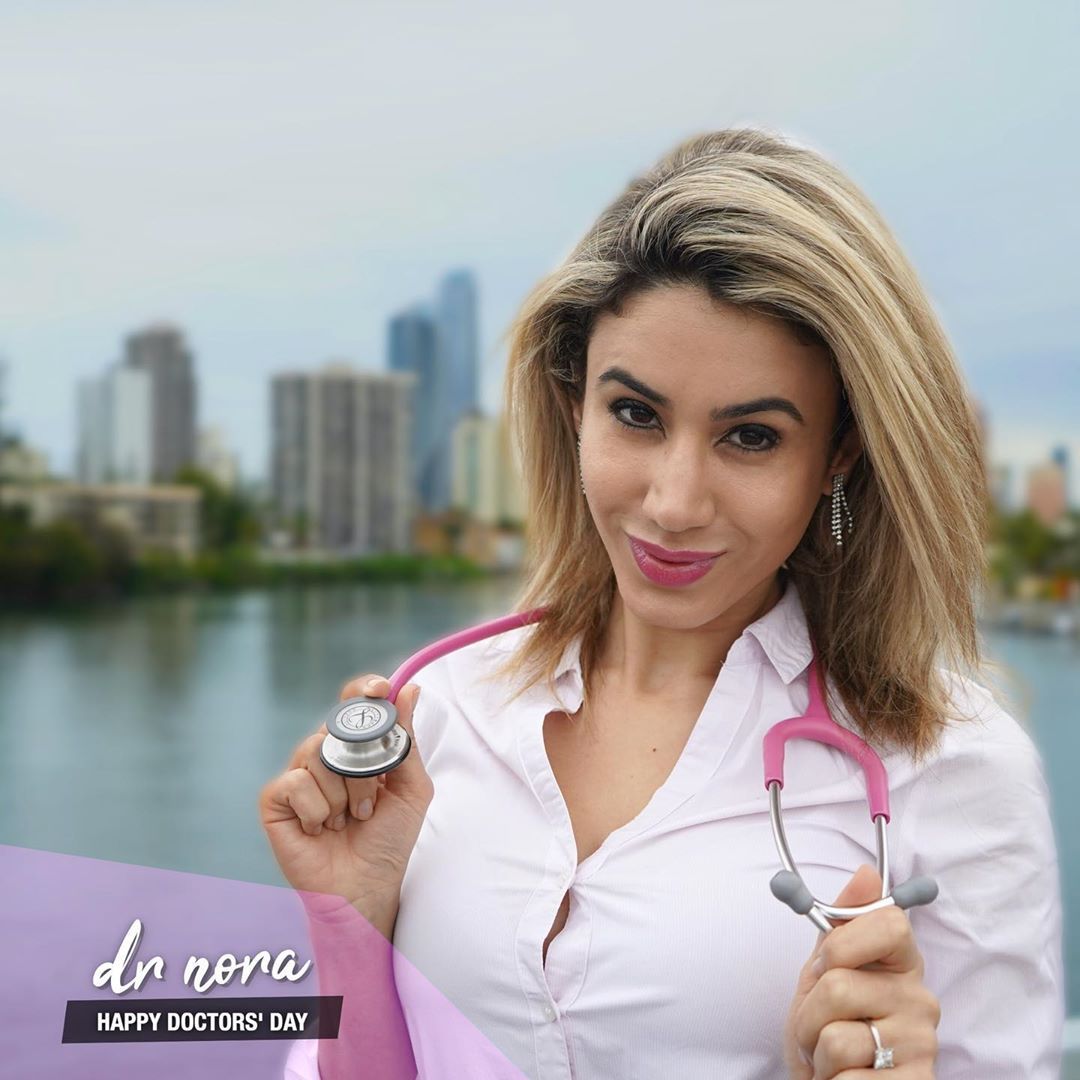
Happy Doctors’ Day 👩⚕️ To my colleagues over in America, I salute you. The 30th March was National Doctors’ day in the US.
It’s through times like the present that we should recognise and celebrate the amazing efforts of doctors and healthcare workers around the globe putting themselves forward for keeping us all safe and sound.
Thank you for the amazing contribution of healthcare professionals, past and present. It is an honour to be part of the team.
With 4 confirmed cases of the novel virus at present in Australia, measures are being taken to help stop the propagation of the virus.
In today’s episode of Dr Nora I talk to you about my battle of finding protective measures to protect myself and my patients.
It is thought that the virus may be transmitted through airborne droplets from sneezing or coughing and it is felt that the P2/N95 mask may offer some protection. As a health care practitioner seeing around 50 patients a day it is my utmost priority to look after my patients and ensure that they are safe. After work I rushed over to my local hardware store and enquired about the mask. Unfortunately, they and all of their other franchises had run out and the only ones left were darth-Vader-esq masks.
After much deliberation I got over the aesthetics and remembered the purpose and brought one. As I drove away I thought I would call local pharmacies to check their stocks. After calling 20 different pharmacies over a span of 60km I was met with the same response ‘sorry we’re out of stock’.
Rather fortunately I drove past the hospital and thought perhaps I could ask my colleagues there and explain the situation. After speaking with the staff in ED they kindly gave me a mask for myself and my staff.
WHAT IS WUHAN CORONAVIRUS?
Wuhan is a city in China where the virus originated from. It is not fully understood how the virus is transmitted but it is believe that it originated in a live seafood market and has so far affected over 1000 people in China with around 40 people dying. It is believed that this who have died from the virus have had underlying medical conditions.
Australia has received its first confirmed case this weekend and to date there are 4 cases in two states, NSW and QLD.
WHAT ARE THE SYMPTOMS?
The virus causes symptoms pneumonia, including, fever, cough, shortness of breath and feeling unwell and tired. It is believed that there is an incubation period of around 14 days which means that someone may not know they have the virus immediately.
WHO IS AT RISK?
Those who have travelled to Wuhan or those who have close contacts with someone who has recently travelled or has a confirmed case.
HOW DO I PROTECT MYSELF?
Usual hygiene measures are crucial such as regular hand washing. It has currently not been recommended for the general public to use a mask outside of the health care setting.
If you have a suspicion you may be affected as perhaps you’ve recently travelled from there or know a close contact. You should maintain isolation and seek medical help. It is imperative that before you go to a doctor or the ED you must call ahead so that protective measures may be taken. You will need to be in isolation to protect others around you and hence stop the propagation of this virus.
Tests can be performed to confirm the virus and treatment may be initiated. The virus is new and not much information has been released. Scientists are working on a vaccination though this can take time.
Together with your help we can stop the propagation of the virus.
In this video we listen to the heart of a patient who has a diagnosis of diastolic dysfunction and a heart murmur.
WHAT IS DIASTOLIC DYSFUNCTION?
Diastolic dysfunction occurs when the left ventricle gets stiffer and is not able to accept blood return in a normal fashion. It can lead to high blood pressure and even heart failure thus requiring regular monitoring and management.
This lovely patient also has a heart murmur that you can clearly hear with the stethoscope. We take a listen to her heart at rest and during exercise.
Thanks for watching and if you have any questions please don’t hesitate to leave me a comment in the comments section below or pop by and see me in clinic.
One in every ten women are affected, no amount of dieting can help and most don’t know it exists… In this episode we talk to a patient diagnosed with Lipoedema and take a listen to her fascinating heart murmur at both rest and during exercise.
LIPOEDEMA
Lipoedema is a condition that mainly affects women and is characterised by symmetrical swelling in the legs, thighs, buttocks and sometimes arms. It is due to the way fat is deposited under the skin in an uneven manner instead of in a regular pattern. It can be extremely painful and the areas that are affected have a tendency to bruise easily. Lipoedema can result in fluid retention in the affected areas leading to a condition known as lymphoedema. It is thought to have a genetic basis, however, the cause of the condition is not yet fully understood.
As we hear in this interview, lipoedema can have a number of effects on the body from having a limited ability to do physical exercise to other medical conditions. As you’ll hear, our patient was incidentally found to have a murmur caused by diastolic dysfunction which is where the heart has trouble relaxing between beats. This means that with each contraction, less blood is pumped from the left ventricle and so the heart has to work harder to make up for this shortfall. This, if not monitored regularly, can lead to conditions such as high blood pressure and even heart failure. We take a listen to the murmur over both the aortic and pulmonary valve during rest and exercise and it’s truly amazing.
Treatment of lipoedema is multi-dimensional and involves psychological support, healthy eating and exercise, skin care, compression therapy and management of pain amongst others. It is often managed through a multidisciplinary team of doctors and therapists.
If you or someone is affected with lipoedema please see your General Practitioner for further assessment and management. There are also a number of useful support groups available.
Thanks for watching and if you have any questions please don’t hesitate to leave me a comment in the comments section below or pop by and see me in clinic.